(We’ve updated the guide with a new section on 10 words to avoid using in emails.)
Deliverability may not be the most interesting part of email marketing, but it is the most important. It doesn’t matter how good your creatives or offers are if they never get to the email inbox.
Getting to the inbox is getting tougher. Earlier this year, Google and Yahoo started enforcing new requirements for bulk email senders. Fortunately, the requirements help reputable email marketers by making best practices mandatory.
Here is your guide to why the requirements were put in place, the impact and cost of deliverability problems and how to ensure your email always goes through.
Table of contents
- Why are email deliverability rules getting tougher?
- What are the new requirements for bulk email senders?
- The cost of email deliverability failure
- Email deliverability success rates are increasing
- Consumers hate email deliverability failures, too
- Email deliverability best practices
- Should I warm up my IP address?
- Can sales engagement tools hurt deliverability?
- 10 words to avoid using in emails
Why are email deliverability rules getting tougher?
“Google, Yahoo and many other mailbox providers are getting more and more frustrated having to deal with spam,” Al Iverson, industry research and community engagement lead at Valimail, told MarTech. “So you have requirements that are tightening up, meant to make it harder to send unwanted and unsolicited emails.”
How big is the spam problem?
“The latest figure I saw was something like 347,000,000,000 emails sent a day,” Cynthia Price, SVP of Marketing at Litmus, told Martech. “And over half of those, depending on which metrics you look at, are estimated to be spam.” That’s 173,000,000,000 spam emails a day.
“The internet service providers, the Googles and the Yahoos and the Microsofts of the world are really, really trying to do everything they can to hold down the fort and protect our inboxes from mayhem,” said Price.
What are the new requirements for bulk email senders?
The new requirements codify the very well-tested best practices of email marketing.
“Best practices are now transitioning to literally written-up requirements that mailbox providers like Gmail and Yahoo post on their website and say, ‘These are the things you have to do now,’” said Iverson, who is also the longtime publisher of The Spam Resource newsletter.
For the most part, the requirements focus on three areas: authentication of outgoing emails, reported spam rates and the ability to easily unsubscribe from email lists.
Authentication
Bulk email senders — generally those sending emails to at least 5,000 addresses a day — must use the following::
- Sender Policy Framework (SPF) helps prevent domain spoofing by allowing senders to identify the email servers sending emails from their domain.
- DomainKeys Identified Mail (DKIM) adds a digital signature to outgoing email, which verifies the message was sent by an authorized sender and wasn’t tampered with along the way.
- Domain-based Message Authentication, Reporting and Conformance (DMARC) helps domain owners specify actions to take when an email fails authentication. It also enables reporting on email authentication results.
Dig deeper: Gmail spam updates are here: What now?
Spam rates
Google says bulk senders must keep their reported spam rate (i.e., the percentage of outgoing messages reported as spam by recipients) in Google Postmaster Tools below 0.1% and “avoid ever reaching 0.3% or higher.”
Yahoo says the spam rate must be below 0.3%.
Unsubscribe
Yahoo and Google require organizations to make it easy for people to unsubscribe.
This means:
- Use of functioning list-unsubscribe header, which supports one-click unsubscribe for marketing and subscribed messages.
- Have a clearly visible unsubscribe link in the email body.
- Process unsubscribe requests within two days.
“No more trying to hide the unsubscribe link or sending people to a landing page that has a phone number on it,” said Price. “I see lots of that still happening and that’s just got to stop. People need to be able to remove themselves from your list because if you force them to stay on it, all you are doing is frustrating them further and encouraging them to mark you as spam every single time.”
The cost of email deliverability failure
According to Mailtrap, the cost of undelivered emails for U.S. businesses is:
- $164+ million daily.
- $1.1+ billion weekly.
- $4.9+ billion monthly.
- $59.5+ billion yearly.
Deliverability problems cost more than $15,000 for every million emails sent, according to a report by Validity.
“A lot of people don’t understand they have deliverability problems until it’s too late,” said Price. “And, much like a credit score, it takes time to build it back up and to be recognized as a safe sender.”
Email deliverability success rates are increasing
- Over the past three years, the average deliverability rate improved from 94.26% in 2020 to 96.43% in 2023.
- The average bounce rate was 1.98%.
- Over the past four years, the ecommerce industry has seen the biggest improvement in deliverability rates (10.28% rise) and a drop in bounce rates (0.7%).
- The overall average unsubscribe rate decreased 26.32% over the past 4 years.
- The overall spam rate went down by 44.4% in 2023 compared to 2020.
Source: Selzy Email Marketing Performance by Industry, 2024 Benchmarks
Dig deeper: New rules for bulk email senders from Google, Yahoo: What you need to know
Consumers hate email deliverability failures, too
Businesses are not the only ones upset when an email doesn’t go through. Consumers want emails when the content interests them. They are unhappy if they don’t get them.
According to a report from Mailgun:
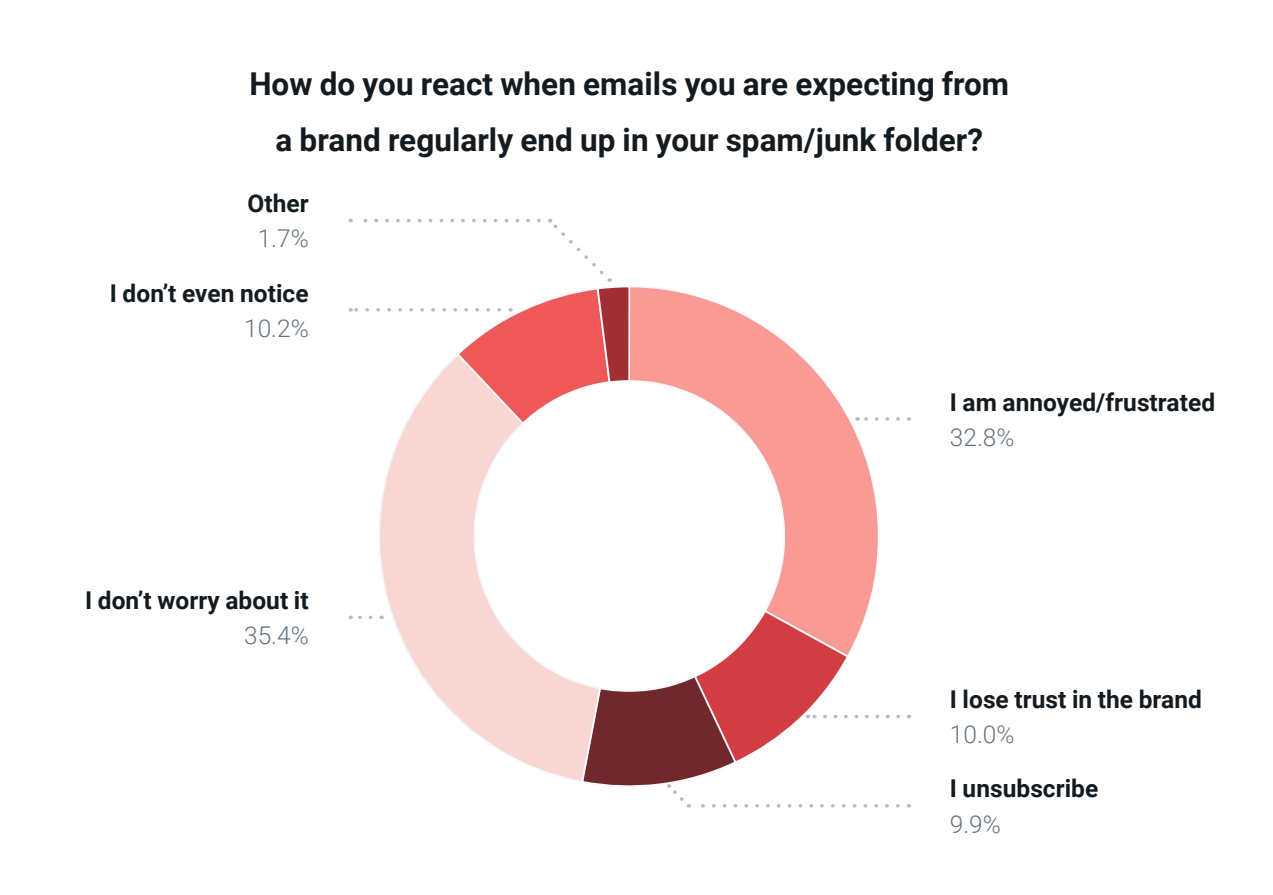
- When emails from a brand regularly land in spam, 52.7% of consumers say they would either feel frustrated, lose trust, or unsubscribe as a result.
- Over 70% of consumers check their spam folders to see if important emails are missing, and almost 33% find it annoying when they find emails from brands in their spam folders.
Email deliverability best practices
Tighter regulations are also clearer regulations. Yahoo and Google are making the requirements very clear to everyone.
“The good news is they are really trying to be transparent about what their algorithms are, how they measure bad practices and what they look for,” said Price. “It’s important to stay up to speed on what those are. What are you supposed to be doing?”
These best practices can be summed up as, “DO NOT SPAM.” Send relevant content to people who’ve said they want to hear from you.
Monitor your inbox placement rate. This tells you if your email program is working and when mailbox providers block messages.
Keep your email lists clean. Be sure there are no spam traps, unknown users and inactive subscribers. Use a double opt-in process to reduce inactive and spam addresses on your list. Use a contact verification solution on your existing list and be sure new addresses are verified as they are added.
Send regularly and consistently. Spammers send emails in different volumes and not at set times. Be sure your email volleys are similar in size and sent at regular intervals. “Implement a preference center so subscribers can say, ‘Actually, I only want one email a month from you, or I want every email you’re ever going to send,’” said Price. “You’ll have both types in your audience, but treating them all the same is really where people get into trouble.”
Monitor sender reputation. Sender reputation is the combination of IP reputation — the trustworthiness an IP has based on its sending history, and domain reputation — the trustworthiness of an email-sending domain based on engagement, spam complaints, bounce rates and more. It is one of the main factors mailbox providers use to determine whether messages should go to the inbox, the spam folder, or be blocked entirely. A Sender Score is a numerical representation of your sender reputation, you can check it for free at SenderScore.org.
Use BIMI to boost trustworthiness. Brand Indicators for Message Identification (BIMI) place a brand logo on your emails, This proves your emails are from a verified, trustworthy sender and are OK to open.
“There are a couple of simple things that should be top of mind, but the most basic of which is just to make sure that the content you’re sending is relevant and valuable to the audience,” said Price. “And that’s the hardest thing to solve for, but that’s what’s going to actually keep people from thinking of you as spam and from marking you as spam.”
Should I warm up my IP address?
Warming up an IP address involves gradually increasing the number of emails sent from a dedicated IP address over four to six weeks. Is it important for deliverability? Absolutely.
“If you have a dedicated IP, 100% you need to be warming it up,” said Price. “One of the biggest signals for the ISPs when they’re looking at email behavior that’s coming into their systems is somebody sending from a fresh IP with a lot of volume.”
Establishing a safe sender history with ISPs is essential. Doing large mailings without that history is a giant red flag for providers because that’s how most fraudulent emails — phishing, spam, malware, etc. — are sent.
“Feed a little wanted mail at first, growing that volume over time,” said Iverson. “You’re spoon-feeding the baby. You let the baby digest it and understand that it’s not going to hurt them, not going to hurt their users.”
Can sales engagement tools hurt deliverability?
Sales engagement tools like Salesloft, Clari and Outreach have the potential to hurt deliverability. It’s not the tools themselves that are the problem, though. It is how the sales team uses them.
“There’s a whole spectrum of sales assistant tools and some are good and some are bad,” said Iverson. “The are tools to find sales leads, intelligence tools to find contacts and information, and stuff like that. If you’re using that to target individuals one-on-one you’re not going to trip the trigger of a spam filter.”
Problems crop up when sales use them to send large numbers of emails while ignoring best practices.
“There is nothing inherent about those tools that makes deliverability harder,” said Price. ”It’s just that a lot of times what we have to do is coach sales teams that the same best practices still apply. So it matters who you’re emailing. How did you get the contacts and how did you put them in the system? It’s okay to send a cold email, but, again, make sure it’s really relevant to the buyer.”
However, as you know, the sales teams’ actions are outside your control and their email behavior can impact your email reputation.
For one thing, relying heavily on templates can result in inadequate personalization. As a result, recipients are more likely to mark messages as spam. In a mass email that can really hurt your reputation. It also won’t help sales because people won’t be responding.
That’s a key point to drive home to sales, who may not understand how the deliverability rules have changed. For both them and you, relevancy is everything.
There is also the issue of improper configuration of email authentication protocols (like SPF, DKIM and DMARC). Many tools take care of this automatically, but it is still worth keeping an eye on when reviewing deliverability metrics.
The most reliable way to protect your brand’s email rep is to set up a separate IP address for sales. That way you don’t have to worry about being harmed by someone else’s behavior.
10 words to avoid using in emails
Email marketers know which words to use to get readers’ attention. Unfortunately, so do email scammers.
A recent study by ZeroBounce analyzed spam emails to identify the 10 most dangerous words. The study used machine learning to analyze large datasets and assigned a weighted score based on frequency, click-through rate, and damage. Keep them in mind when writing email campaigns and checking for spam issues.

It’s no surprise these words are all related to money, which is itself the most popular and riskiest word. The good news is that unless you are in financial services, you won’t need to use them often.
Interestingly “Free” — the ultimate sales gimmick word — has the highest appearance frequency (2,266) but the lowest click-through rate (0.56%). Maybe we are all getting wiser.
Connect with your email marketing peers at the Fall MarTech Conference, available online and free, Sept. 25–25, 2024. The program features a Coffee Talk session on Navigating modern email marketing.
The post Email deliverability: What you need to know appeared first on MarTech.